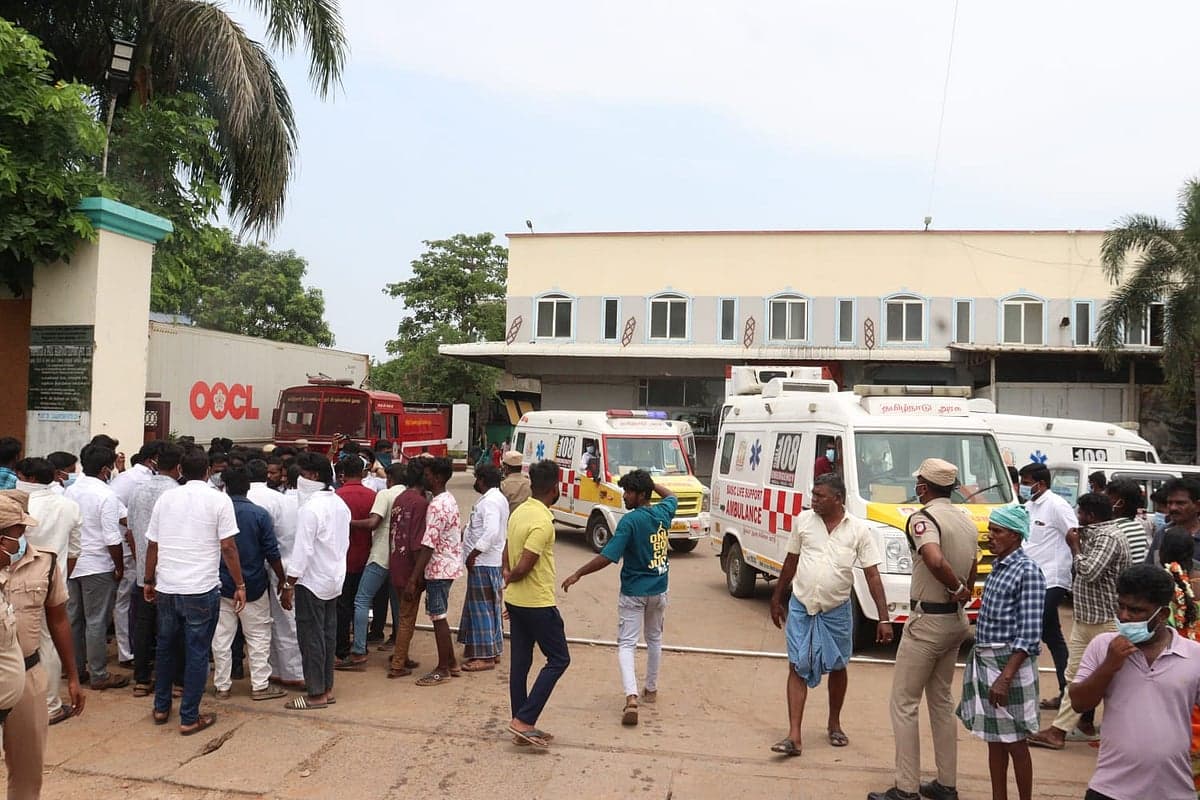
Industrial Safety Alert
Tiruvallur Ammonia Leak: Five Workers Dead at Seafood Unit, Safety Compliance Comes Under Scrutiny
Five women workers died and 67 remain under treatment after ammonia gas leaked from St Peter & Paul Sea Foods Exports at Kannigaipair near Periyapalayam. Updated 22 June with official health bulletin figures.
Latest update
Monday, 22 June 2026
- State Health and Family Welfare Department bulletin confirms five deaths — two on Sunday night and three on Monday morning. All five deceased workers are women from Odisha.
- Of 74 workers exposed to the gas, 67 remain under medical observation and two have been discharged.
- The leak occurred around 11 am on Sunday while workers were off duty and resting in hostel rooms about 50 metres from the ammonia plant.
- Health Minister K. G. Arunraj said experts recorded ammonia levels of around 300 ppm at the plant. NDRF teams confirmed the gas had spread to worker accommodation.
- Police registered a case under BNS Sections 105 and 125(a). Unit owners Mohan and Joseph were detained for inquiry.
- Chief Minister C. Joseph Vijay ordered a three-member committee to complete a detailed probe within three days and announced ₹2 lakh compensation per family.
- Labour Minister J. Mohamed Farvas told the Assembly the government will constitute a committee to inspect hazardous industries statewide.
Early Sunday reports cited seven deaths. The official health bulletin on Monday revised the confirmed toll to five.
Chennai / Tiruvallur, June 21–22, 2026: A major industrial safety tragedy near Chennai has raised urgent questions about hazardous chemical handling, worker accommodation inside factory premises and the depth of regulatory inspection in food-processing and cold-storage industries. An ammonia gas leak at a private seafood export unit in Kannigaipair near Periyapalayam in Tiruvallur district on Sunday left five women workers dead and 67 others under treatment as of Monday morning, according to a state health bulletin.
The unit has been identified as St Peter & Paul Sea Foods Exports Private Limited, a seafood processing and export facility in the Kannigaipair/Manjangaranai area near Periyapalayam. The leak occurred around 11 am on Sunday while many migrant workers were off duty and resting in hostel rooms about 50 metres from the unit's ammonia plant.
Most affected workers are young women from Odisha, Jharkhand, Assam and West Bengal. The National Disaster Response Force said the gas spread to worker accommodation. About 130 workers who were not affected were shifted to the Govinda Bhavanam marriage hall in Kannigaipair, where food and drinking water were arranged.
What Happened at the Facility
Leak reported
Ammonia gas leak around 11 am on Sunday, 21 June, at St Peter & Paul Sea Foods Exports in Kannigaipair during routine operations.
Workers hospitalised
74 workers exposed; victims rushed to government and private hospitals with breathlessness, eye irritation, and respiratory distress.
Official toll confirmed
Health bulletin on Monday confirms five deaths — two Sunday night, three Monday morning. Sixty-seven remain under treatment; two discharged.
NDRF deployed
NDRF CBRN team deployed; gas had spread to worker hostel accommodation about 50 metres from the ammonia plant.
Probe and arrests
Police case under BNS; owners detained. CM forms three-member committee for a three-day inquiry; statewide hazardous-industry inspection ordered.
Location
Kannigaipair is near Periyapalayam in Tiruvallur district, north of Chennai city. The seafood export unit operates in this industrial corridor.
The ammonia gas leak was reported from the seafood processing section of the plant. Workers exposed to the gas complained of breathlessness, eye and respiratory tract irritation, coughing, chest discomfort, and varying degrees of respiratory distress. The affected workers were rushed to nearby government and private hospitals for emergency care.
Health Minister K. G. Arunraj said experts recorded ammonia levels of around 300 ppm in the air at the plant. Police personnel from Periyapalayam, Fire and Rescue Services, revenue officials and health department teams reached the spot and carried out rescue operations.
Following a request from the district administration, the National Disaster Response Force deployed a specialised Chemical, Biological, Radiological and Nuclear response team. NDRF officials said the gas had spread to workers' accommodation, causing breathing difficulties. Periyapalayam police registered a case under Sections 105 and 125(a) of the Bharatiya Nyaya Sanhita. Unit owners Mohan and Joseph were detained for inquiry.
Chief Minister C. Joseph Vijay formed a three-member committee to probe the incident and directed that a detailed inquiry be completed within three days. The government announced ₹2 lakh compensation for each bereaved family, pledged to bear the cost of transporting bodies to native states, and said PF and ESI benefits would be released immediately. The exact mechanical cause of the leak has not yet been officially confirmed.
Why Ammonia Is Used in Seafood Processing Units
Large seafood processing units require heavy cooling capacity. Fish, shrimp and other marine products must be chilled, frozen and stored at controlled temperatures before export. For this reason, many large seafood, meat, dairy, cold-storage and frozen-food facilities use ammonia-based refrigeration systems.
Ammonia is efficient for industrial-scale refrigeration. It can absorb heat quickly and is widely used in blast freezers, plate freezers, cold rooms and large chilling systems. However, this efficiency comes with serious safety responsibility. Ammonia is toxic and corrosive when released into occupied spaces. It can affect the lungs, throat, eyes and skin. In a closed factory or worker accommodation zone, a leak can quickly become life-threatening if warning systems, ventilation, isolation valves and evacuation procedures fail or are delayed.
In this case, the gas did not come from seafood decay. It was most likely connected to the industrial refrigeration infrastructure used in the processing unit. The exact point of failure — whether a pipe, valve, compressor room, cylinder, pressure system, electrical system or maintenance lapse — is still a matter for official investigation.
How ammonia refrigeration works in a seafood plant
Red-outlined nodes mark common danger points: valves, pipelines, compressor room, storage receiver, and closed rooms.
Worker Accommodation Inside Industrial Premises: A Serious Safety Question
One of the most worrying aspects of this tragedy is the reported presence of worker accommodation inside the factory premises. Many export units and food-processing facilities employ migrant workers from other states. Providing accommodation is common in labour-intensive industries. But housing workers inside or close to hazardous machinery, refrigeration rooms, chemical storage areas or high-pressure pipelines creates a serious risk if safety zoning is weak.
Worker accommodation must not become a silent extension of the factory floor. Sleeping areas, kitchens, dining spaces, toilets and rest areas must be clearly separated from hazardous process zones. Accommodation blocks must have independent exits, ventilation, alarms and evacuation paths. If workers are housed inside a campus where ammonia, boilers, chemicals, pressure vessels or heavy refrigeration systems are present, emergency planning must consider night-time and holiday exposure, not only working-hour exposure.
The incident happened while workers were off duty on Sunday, not during active processing shifts. This makes the safety concern sharper. A worker may not be operating machinery, but if accommodation sits within roughly 50 metres of an ammonia plant, the worker remains exposed to industrial hazards even while resting.
Compliance Norms Companies Must Follow
This incident should trigger a detailed safety audit of seafood processing units, shrimp processing units, cold-storage facilities, ice plants, dairy units, meat-processing units and logistics warehouses using ammonia-based refrigeration systems across Chennai, Tiruvallur, Ennore, Gummidipoondi, Red Hills, Minjur and nearby industrial belts.
Companies handling ammonia and other hazardous substances must maintain valid factory licences, pressure-vessel certifications, refrigeration-system inspection records, compressor maintenance logs, leak-detection alarms, emergency ventilation systems, automatic shut-off systems, safety valves, electrical safety approvals, fire safety clearance, worker training records, safety data sheets, emergency response plans, mock-drill records and evacuation protocols. They must also ensure that trained operators are available, personal protective equipment is accessible, ammonia detectors are functional, and alarms are audible in work areas as well as accommodation areas.
Where workers are housed within factory premises, officials must verify whether accommodation areas are safely separated from machinery rooms, ammonia pipelines, cylinders, compressors, receivers and cold-storage systems. Compliance cannot be reduced to documents filed in an office. It must be verified through physical inspection, live testing of alarms, checking of ventilation systems, review of maintenance records and surprise emergency drills.
Licences & Approvals
- Valid factory licence
- Approved building layout
- Pressure-vessel certification
- Fire safety clearance
- Electrical safety approvals
Refrigeration Safety
- Compressor maintenance logs
- Pipeline integrity inspection
- Functional ammonia gas detectors
- Emergency shut-off valve accessibility
- Pressure relief valve records
Worker Protection
- Safety training records
- PPE availability including respirators
- Safety Data Sheet for ammonia
- Multilingual evacuation maps
- Accommodation separated from hazardous zones
Emergency Readiness
- Alarm audibility in work and accommodation areas
- Emergency ventilation test records
- Mock-drill frequency and attendance
- Clear emergency exits and assembly areas
- Night-time and holiday response plan
Paper compliance is not safety compliance.
Officials Who Must Scrutinise High-Risk Facilities
A tragedy of this nature cannot be treated as the responsibility of only one department. Ammonia refrigeration sits at the intersection of industrial safety, labour welfare, fire safety, pollution control, disaster management and local governance.
The Directorate of Industrial Safety and Health must examine factory licensing, hazardous process handling, safety systems, pressure equipment and worker safety practices. Fire and Rescue Services must verify emergency access, gas leak response readiness, evacuation routes, alarm systems and fire-safety infrastructure. Tamil Nadu Pollution Control Boardmust examine hazardous chemical handling, environmental risk, emergency response preparedness and whether the facility's operations create off-site risk. District administration and disaster management authorities must ensure that chemical emergency planning covers nearby communities, worker housing and transport routes. Labour officials must examine worker accommodation, migrant worker registration, welfare facilities and whether workers were properly trained on emergency response. Local bodies must check building safety, drainage, access roads and occupancy conditions.
Export-linked regulators and food safety authorities must also ensure that export-oriented production does not ignore basic occupational safety. A facility may meet product quality standards for international markets, but that does not automatically mean it is safe for the workers who process those products.
On Monday, Labour Minister J. Mohamed Farvas told the Tamil Nadu Legislative Assembly that the government would immediately constitute a committee to inspect hazardous industries across the State. He said reports from DISH, the Public Health Department and TNPCB had been sought within 24 hours.
Accountability Map
What Investigators Must Establish
The official inquiry must go beyond identifying the immediate leak point. It must establish whether the ammonia refrigeration system was properly designed, maintained and inspected. Investigators must examine whether the machinery room had functional gas detectors, whether alarms triggered in time, whether emergency ventilation worked, whether pressure relief systems were maintained, whether workers knew evacuation procedures, whether emergency exits were clear, and whether trained personnel were available when the leak happened.
The probe must also check whether earlier warning signs were ignored. Ammonia leaks are often preceded by odour complaints, valve issues, vibration, corrosion, pressure changes, compressor faults, poor insulation, faulty sensors or maintenance delays. Every maintenance log, inspection report, breakdown record, repair invoice and safety audit report must be examined.
The key question is not only “where did the gas leak from?” The larger question is: “why did the safety layers fail to prevent deaths?”
Investigation Tracker
Leak Source
Awaiting official confirmation
Maintenance History
Awaiting official confirmation
Alarm Function
Awaiting official confirmation
Ventilation
Awaiting official confirmation
Evacuation
Awaiting official confirmation
Accommodation Safety
Awaiting official confirmation
Pattern of Industrial Safety Risks Around Chennai
Chennai and its surrounding industrial districts have multiple high-risk zones: Ennore, Manali, Gummidipoondi, Tiruvallur, Sriperumbudur, Oragadam, Red Hills, Minjur and the port-linked logistics corridor. These regions contain chemical units, warehouses, food-processing facilities, cold chains, oil and gas infrastructure, fertiliser-linked operations and manufacturing units.
In recent years, ammonia leaks and industrial accidents have repeatedly shown that Chennai's growth as an industrial and logistics hub must be matched by stronger safety governance. The Ennore ammonia leak in 2023 caused public concern after residents reported breathing difficulty and eye irritation. The present Tiruvallur incident is different in location and industry, but it raises the same public question: are hazardous substances being handled with sufficient transparency, inspection and emergency preparedness?
For a fast-growing metro region, industrial safety cannot remain hidden behind compound walls. Nearby residents, workers, transporters, local bodies and emergency responders must know what risks exist and how response systems are activated.
Industrial safety risks require coordinated regional monitoring.
The Human Cost Behind Export Supply Chains
Seafood exports depend heavily on manual processing, cleaning, sorting, packing and freezing work. Many workers in these units are migrants who live far from their home states and depend on factory-linked accommodation. Their safety depends on systems they may not fully understand and emergency instructions that may not be given in their own language.
Worker safety training must be multilingual. Emergency alarms must be visual as well as audible. Evacuation routes must be repeatedly demonstrated. Workers must know where to run, whom to call, what not to touch and how to respond to gas exposure. A safety briefing given only once at joining is not enough.
Companies that export to global markets must adopt global-grade worker protection. International buyers, auditors and regulators must also examine whether supply chains are safe not only for product quality, but also for the people working behind the product.
“Export quality cannot be built on unsafe worker housing.”
Worker safety training, multilingual evacuation signage, and separated accommodation are essential in export-linked food processing units.
What Must Change Immediately
The Tiruvallur tragedy should result in immediate inspection of all ammonia-based refrigeration facilities in the region. Authorities must prioritise units where workers are housed inside the campus, where refrigeration systems are old, where maintenance is outsourced without accountability, or where emergency drills are not regularly conducted.
Every such facility must be asked to demonstrate working ammonia detectors, emergency ventilation, shut-off systems, pressure relief valves, alarm audibility, PPE availability, emergency exits, safe assembly areas and multilingual evacuation training. Worker accommodation should be reviewed as a separate safety category. No worker should be housed in a zone where a gas leak from a machinery room can reach sleeping quarters without warning.
Industrial safety inspections should not be announced ceremonial visits. They must include document checks, physical checks, functional testing, worker interviews and night-time emergency readiness evaluation.
Inspect all ammonia-based refrigeration facilities in Tiruvallur and Chennai belt immediately.
Prioritise units where workers are housed inside the campus.
Review facilities with old refrigeration systems or outsourced maintenance without accountability.
Verify working ammonia detectors, emergency ventilation, and shut-off systems.
Test alarm audibility in both work areas and accommodation blocks.
Confirm pressure relief valves, PPE availability, and emergency exits.
Review worker accommodation as a separate safety category.
Ensure no sleeping quarters fall within a gas-leak risk envelope without warning.
Conduct unannounced inspections with document checks, physical checks, and functional testing.
Include night-time and holiday emergency readiness in every inspection.
Editorial View: Inspection Before Disaster, Not After Death
This tragedy is not only about one factory or one refrigeration system. It is about the way industrial safety is inspected, documented and enforced. Ammonia refrigeration is not new technology. Its risks are known. Its safety systems are known. The need for trained operators, leak detection, ventilation, emergency shutdown and evacuation planning is also known. When deaths occur, the failure is rarely a mystery; it is usually a chain of missed safeguards.
Chennai's industrial expansion must not treat worker safety as a secondary cost. Export units, cold chains, warehouses and processing plants are important to the economy. But economic activity cannot be allowed to proceed with weak safety separation, poor emergency planning or paper-only compliance.
The lesson from Kannigaipair must be direct: hazardous industrial systems require real inspection, real maintenance, real drills and real accountability. Safety must be verified before an accident, not written about after lives are lost.
Suggested Compliance Checklist for Officials
Officials inspecting ammonia-based refrigeration facilities should verify:
Conclusion
The Kannigaipair ammonia leak has exposed a dangerous gap between industrial operations and worker safety. Five workers have lost their lives, and dozens of others remain under treatment after exposure to a toxic gas. The official investigation must determine the exact cause, but the broader safety lesson is already clear.
Every ammonia-based facility in Chennai and surrounding districts must now be reviewed. Companies must prove that safety systems work. Officials must inspect beyond paperwork. Worker accommodation must be treated as a high-risk safety issue when located inside industrial campuses.
The purpose of regulation is not to react after death. It is to prevent death.
Primary reporting: The New Indian Express (22 June update) · Day-one report (21 June) · The Hindu. This article is MyChennaiCity editorial analysis on industrial safety compliance. See more Chennai local news.
Published 21 June 2026 · Updated 20 July 2026 · Category: Chennai · Tags: Tiruvallur, Ammonia Leak, Industrial Safety, Worker Safety
Explore the site
More from mychennaicity.in
Chennai today, local news, jobs, events, gold rate, and a moderated WhatsApp community — one city desk.
- Chennai today60-second morning card
- WhatsApp communityModerated Chennai updates
- Chennai local newsCivic desk & neighbourhood stories
- Afford this areaTake-home vs rent check
- Jobs in ChennaiOpen roles across the city
- Which Chennai are you?Playful neighbourhood quiz
New here? How to use mychennaicity.in — guides for residents, job seekers, admins, and more.
Promote your business to Chennai readers
Get visibility across local news, events, jobs and area pages.
Reader group: The my chennai city reader group — short updates and civil discussion, same standards as the site. Opens WhatsApp after you tap.
Tip the Chennai desk
Spotted something we should look at — safety, civic works, consumer rip-offs, or a human story? A short message is enough; links and dates help.