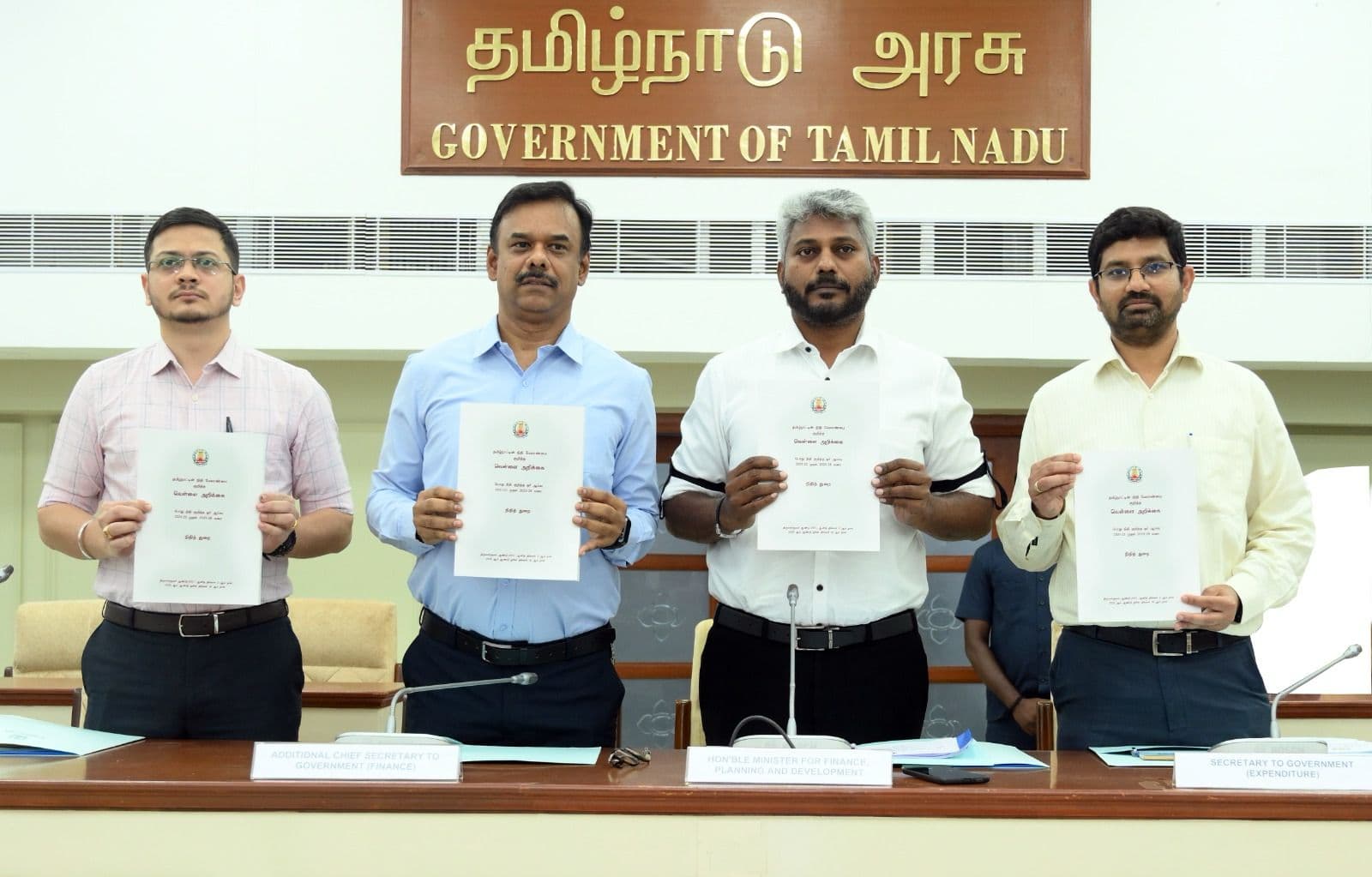
Fiscal White Paper 2026
Tamil Nadu’s ₹13.18 Lakh Crore Warning: Debt Is Only the Symptom, Political Evasion Is the Disease
The White Paper is political. The numbers are still serious. Tamil Nadu’s real crisis is not bankruptcy, but a shrinking fiscal room for welfare, investment and future promises.
₹10 lakh crore
Direct outstanding liabilities
₹13.18 lakh crore
Aggregate fiscal exposure
₹78,324 crore
Revenue deficit
₹67,050 crore
Annual interest payments
5.45%
SoTR / GSDP
87%
Revenue pre-committed
Tamil Nadu's latest fiscal White Paper is not merely a government document. It is a political weapon, a financial warning, and a test of public seriousness.
The Vijay government has presented it as an evidence-based account of Tamil Nadu's finances. That claim deserves attention. But it also deserves scrutiny. No government releases a White Paper on the previous fiscal period in a political vacuum. A document of this kind does two things at once: it reveals numbers, and it frames blame.
The central question, therefore, is not whether the White Paper is political. It is. The question is whether its numbers are serious enough to survive the politics around them.
They are.
Section 1
The number that will dominate politics
Do not confuse the twoThe figure dominating public debate is ₹13.18 lakh crore. But that figure must be handled carefully. It should not be casually described as Tamil Nadu's direct debt.
The direct outstanding liabilities are closer to ₹10 lakh crore. The ₹13.18 lakh crore figure is broader: it includes wider fiscal exposure, including the liabilities and risks sitting inside public sector undertakings, guarantees and loss-making state entities.
That distinction matters. If critics call the entire ₹13.18 lakh crore “debt”, the opposition can dismiss the argument as exaggeration. The more accurate and more dangerous phrase is this: Tamil Nadu's aggregate fiscal exposure is approaching ₹13.18 lakh crore.
This is not just accounting language. It tells us that part of Tamil Nadu's financial burden is visible in the Budget, and part of it is hidden in institutions that depend on the State when they fail.
Direct outstanding liabilities
₹9,99,832 cr
Approximate 2025-26 Pre-AC figure
Aggregate fiscal exposure
₹13.18 lakh cr
Direct debt plus PSU-linked exposure
Government guarantees
₹1,79,782 cr
Nearly three-fold rise since April 2021
Power sector debt
₹2.47 lakh cr
Largest PSU-linked risk
Tamil Nadu's visible and hidden fiscal burden
Section 2
Strong State, weak fiscal discipline
Tamil Nadu is not a poor State. It has industry, services, exports, ports, cities, skilled labour, social infrastructure and one of India's strongest welfare legacies.
A strong State can carry debt. Debt itself is not immoral. Debt used for roads, schools, hospitals, water systems, public transport, industrial corridors and future productivity can be justified.
The danger begins when debt is used to keep today's political machine running.
Debt is not the disease. Borrowing for current expenditure is.
Section 3
The real warning is revenue deficit
That is why the revenue deficit number is more important than the headline debt number.
The White Paper says Tamil Nadu's revenue deficit touched ₹78,324 crore in 2025-26. In simple terms, the government is borrowing not only to build assets, but to meet current expenditure. It is the equivalent of a household taking loans not to buy land or build a house, but to pay monthly bills.
That may be unavoidable during a pandemic. It is not acceptable as a permanent governing style.
Tamil Nadu's debt-to-GSDP ratio has not exploded in the way casual political debate may suggest — outstanding liabilities as a share of GSDP moved from 28.7% to 28.3% across the White Paper window. The sharper criticism is that Tamil Nadu failed to consolidate when it had the chance.
After COVID, States such as Karnataka, Maharashtra and Gujarat used recovery years to improve or stabilise their fiscal position. Tamil Nadu, according to the White Paper, remained stuck with elevated debt, persistent revenue deficit and falling own-tax effort.
In finance, standing still while peers repair themselves is also decline.
Outstanding liabilities rose; debt ratio stayed elevated
Debt-to-GSDP hovered near 28% — the issue is persistence and missed consolidation, not a sudden ratio spike.
2021-22 revenue deficit
₹46,538 cr
2025-26 revenue deficit
₹78,324 cr
Section 4
The tax effort problem
The White Paper is especially severe on tax effort. Tamil Nadu's State Own Tax Revenue as a share of GSDP declined from 5.93% in 2021-22 to 5.45% in 2025-26. Total Revenue Receipts reportedly fell from around 10% of GSDP to 8.32%.
For a State with Tamil Nadu's industrial base, consumption economy and urbanisation, this points to leakages, tax underperformance, weak enforcement, political reluctance, or a combination of all four.
Tamil Nadu's welfare model has historical legitimacy — but welfare cannot become a shield for fiscal indiscipline. A welfare State that cannot collect taxes efficiently, control procurement costs, reform loss-making utilities and protect capital expenditure eventually damages the very people it claims to protect.
Tamil Nadu's own-tax effort has weakened
Peak reference 6.33% (2022-23). White Paper estimates ₹51,000 crore revenue foregone against that peak.
SoTR / GSDP
5.45%
2025-26 Pre-AC
Total revenue / GSDP
8.32%
Down from ~10%
Revenue foregone
₹51,000 cr
Vs 2022-23 peak
Pre-committed receipts
87%
After inflexible obligations
Section 5
Interest is the silent budget killer
Annual interest payments rose from ₹41,564 crore in 2021-22 to ₹67,050 crore in 2025-26. This is money already committed before a minister announces a new scheme or a collector gets a new project.
The most politically damaging line in the White Paper is that interest payments now exceed capital expenditure — Tamil Nadu spends more to service yesterday's borrowing than to build tomorrow's assets.
Interest does not cut ribbons. It quietly eats the Budget.
Interest payments (₹ crore)
2025-26 interest-to-capital expenditure ratio: 1.32:1
Shadow budget
Power sector — the shadow budget
When distribution losses, tariff gaps, regulatory assets, delayed subsidy payments and utility borrowings accumulate, the cost does not disappear. It returns through State guarantees, budget support, tariff pressure or future borrowing.
Tamil Nadu's power entities, transport corporations and civil supplies system are fiscal engines. When they run losses year after year, they weaken the State's borrowing capacity.
Major PSU-linked debt
₹3.18L cr
Power, transport, civil supplies
Power sector debt
₹2.47L cr
Largest entity exposure
Accumulated power loss
₹1.82L cr
Long-term structural stress
Govt guarantees
₹1.79L cr
Nearly 3× since Apr 2021
The counter-case
The opposition's counterargument
The previous government and its defenders can argue that Tamil Nadu's welfare commitments are heavier than peer States, that social-sector spending produces long-term returns, and that GST compensation, central transfers and disaster response all matter.
Some of those arguments have merit. But they do not erase three hard facts.
- A persistent revenue deficit means borrowing for current expenditure.
- Declining own-tax effort cannot be blamed entirely on the Centre.
- Loss-making PSUs cannot be permanently hidden behind social-policy language.
The White Paper may be political. But weak rebuttals will not defeat it. Only better numbers can.
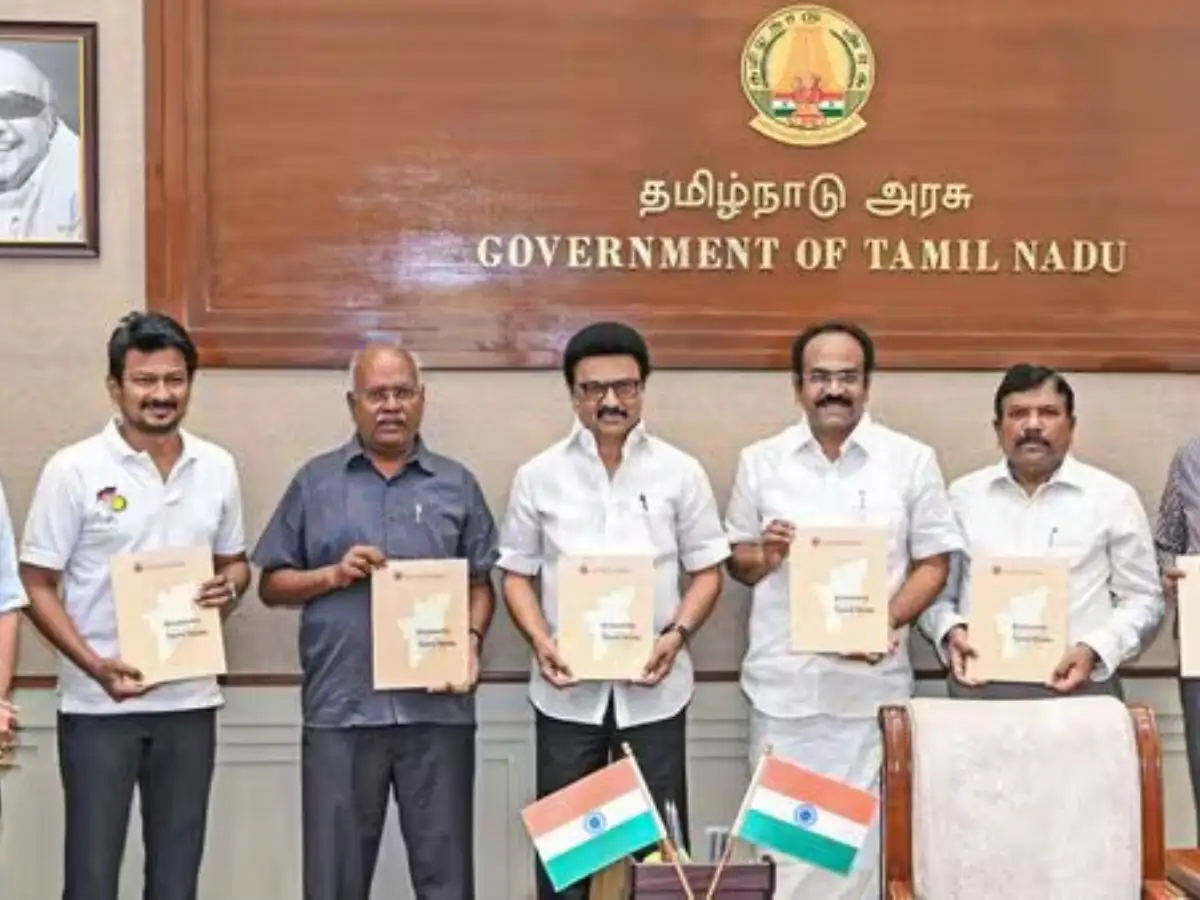
Political reaction
Empty paper or hard numbers?
Former finance minister Thangam Thennarasu's reported dismissal of the document as an “empty paper” is politically predictable. But the public question is practical: which numbers are wrong, which assumptions are misleading, and what is the alternative fiscal path?
Calling it an empty paper is not enough. A serious opposition must produce a counter-audit, not just a counter-slogan. The Vijay government also cannot stop at disclosure — a White Paper is only the opening statement.
Government framing
Evidence-based account of fiscal deterioration
Opposition attack
Not a White Paper, but an empty paper
Reform path
What real correction requires
1
Plug tax leakage
2
Clean procurement
3
Reform power-sector finances
4
Protect capital expenditure
5
Publish quarterly fiscal truth
Demography
Demography makes the window smaller
Tamil Nadu's crisis is not bankruptcy — that is exaggerated language. The State has economic depth, administrative capacity and social capital. It can correct course.
But it faces a narrowing window: an ageing population, rising welfare commitments, growing interest burden, hidden PSU stress, and a political culture that rewards announcements faster than discipline.
Elderly share 2011 → 2031
10.6% → 18.2%
Old-age dependency 2021 → 2036
20.6 → 32.7
Published 17 June 2026 · Economy desk
Explore the site
More from mychennaicity.in
Chennai today, local news, jobs, events, gold rate, and a moderated WhatsApp community — one city desk.
- Chennai today60-second morning card
- WhatsApp communityModerated Chennai updates
- Chennai local newsCivic desk & neighbourhood stories
- Afford this areaTake-home vs rent check
- Jobs in ChennaiOpen roles across the city
- Which Chennai are you?Playful neighbourhood quiz
New here? How to use mychennaicity.in — guides for residents, job seekers, admins, and more.
Promote your business to Chennai readers
Get visibility across local news, events, jobs and area pages.
Reader group: The my chennai city reader group — short updates and civil discussion, same standards as the site. Opens WhatsApp after you tap.
Tip the Chennai desk
Spotted something we should look at — safety, civic works, consumer rip-offs, or a human story? A short message is enough; links and dates help.