Chennai enters the Northeast Monsoon with reservoirs at just 39%: what the numbers mean for 2027 water security
The Northeast Monsoon, not this September snapshot, will decide how the city enters summer 2027.
On 29 September 2026, CMWSSB put Chennai’s five main reservoirs at 4,569 mcft — 38.9% of capacity — against 7,853 mcft on the same date in 2025.
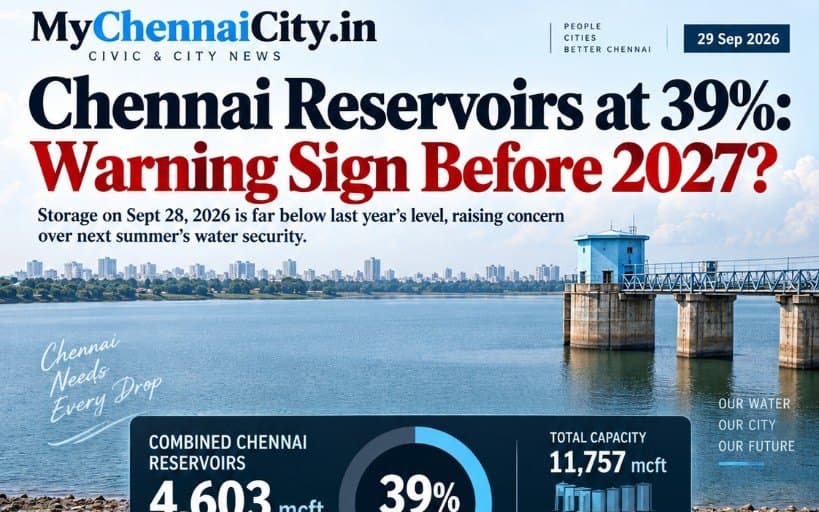
Chennai enters the Northeast Monsoon with reservoirs at just 39%: what the numbers mean for 2027 water security — Chennai, Chennai local news
Location
Teynampet & Nungambakkam
Published
29 Sept 2026
Topic
Chennai
Primary source
CMWSSB lake storage, 29 September 2026
Status
Published & verified editorial
What we know
Summary
Chennai, 29 September 2026 — The city is entering the Northeast Monsoon with its five principal drinking-water reservoirs at 4,569 million cubic feet, or 38.9% of their 11,757 mcft combined capacity.
On the same date in 2025, the CMWSSB table records 7,853 mcft in those five lakes, about 66.8% full. That is a year-on-year gap of 3,284 mcft — roughly 42% less water than last year’s same-day storage.
A desk graphic dated 28 September put the same five lakes at 4,603 mcft, or 39.15%. The 29 September board reading is 34 mcft lower. The monsoon, not this September snapshot, will decide whether summer 2027 is comfortable or a return to groundwater stress, tanker queues and supply restrictions.
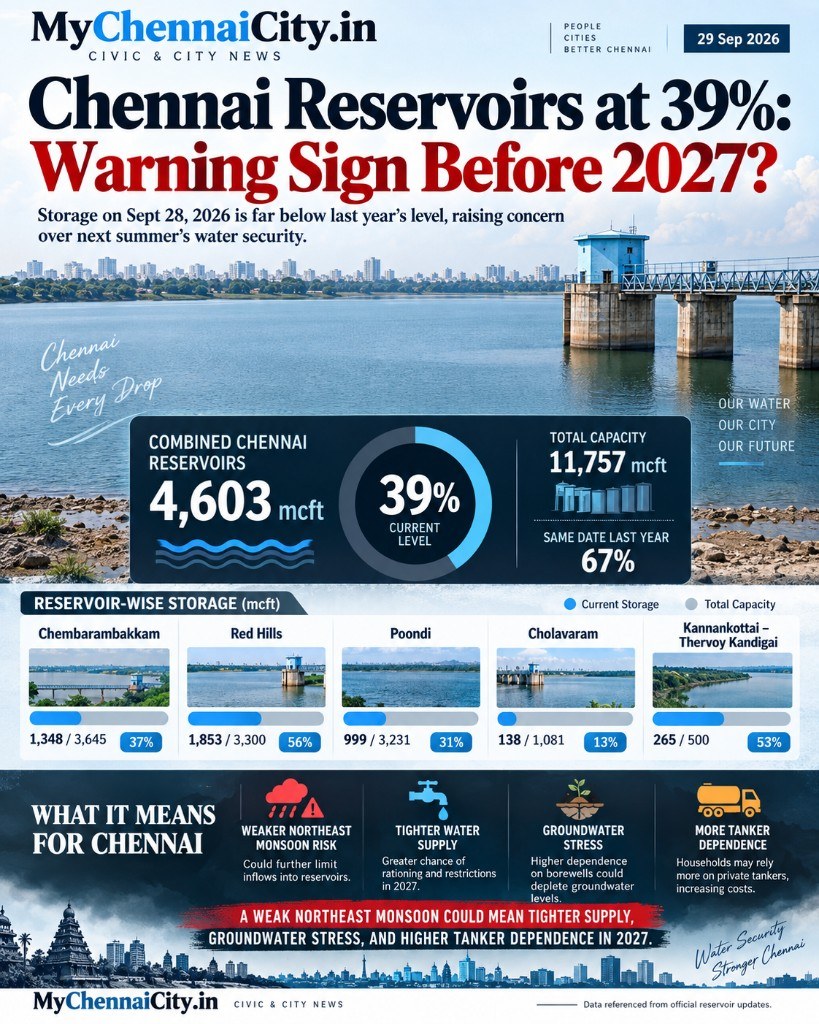
The graphic is the 28 September position. The table below is the CMWSSB reading for 29 September.
Reservoir position on 29 September
CMWSSB lake storage as on 29 September 2026. Rainfall at every lake that day is listed as 0.00 mm.
| Reservoir | Capacity (mcft) | Storage (mcft) | Fill | Same date 2025 (mcft) |
|---|---|---|---|---|
| Poondi | 3,231 | 981 | 30.4% | 2,518 |
| Cholavaram | 1,081 | 136 | 12.6% | 181 |
| Red Hills / Puzhal | 3,300 | 1,856 | 56.2% | 2,928 |
| Kannankottai–Thervoy Kandigai | 500 | 264 | 52.8% | 438 |
| Chembarambakkam | 3,645 | 1,332 | 36.5% | 1,788 |
| Five-reservoir total | 11,757 | 4,569 | 38.9% | 7,853 |
| Veeranam (separate) | 1,465 | 449.6 | 30.7% | 1,246 |
The board’s own grand total, which includes Veeranam, is 5,018.6 mcft of 13,222 mcft (38.0%), against 9,099 mcft on the same date last year.
On 29 September the table also shows water leaving the lakes with little coming in. Poondi is listed at 80 cusecs inflow and 294 cusecs outflow. Red Hills is nearly balanced (210 in, 204 out). Chembarambakkam shows 209 cusecs outflow and no inflow figure. Cholavaram and Kannankottai–Thervoy Kandigai likewise show outflow and a blank inflow cell.
What the 28 September graphic showed
The graphic released with this report used the previous day’s position:
| Reservoir | Capacity (mcft) | Storage (mcft) | Fill |
|---|---|---|---|
| Chembarambakkam | 3,645 | 1,348 | 37.0% |
| Red Hills / Puzhal | 3,300 | 1,853 | 56.2% |
| Poondi | 3,231 | 999 | 30.9% |
| Cholavaram | 1,081 | 138 | 12.8% |
| Kannankottai–Thervoy Kandigai | 500 | 265 | 53.0% |
| Five-reservoir total | 11,757 | 4,603 | 39.15% |
Those 28 September figures are not last year’s storage. Last year’s comparison is the CMWSSB “same date” column: 7,853 mcft on 29 September 2025, against 4,569 mcft now.
Fact check
At a glance
- Five Chennai reservoirs on 29 September 2026: 4,569 / 11,757 mcft (38.9%)
- Same date in 2025: 7,853 mcft (66.8%)
- Gap: 3,284 mcft
- 28 September graphic: 4,603 mcft (39.15%)
- Empty space in the five lakes: about 7,188 mcft
- Veeranam: 449.6 / 1,465 mcft (30.7%), against 1,246 mcft a year earlier
- Rainfall listed at the lakes on 29 September: 0.00 mm
Veeranam is a separate number
Veeranam matters to Chennai, and it should not be added into the five-lake total as if it were another Poondi.
The lake sits on the Cauvery system. What it can send towards the city depends on storage upstream, irrigation demand and releases, not only on rain over Chennai, Tiruvallur and Kancheepuram. On 29 September it held 449.6 mcft, about 31%, with 330 cusecs inflow and 73 cusecs outflow. A year earlier the same table shows 1,246 mcft.
Treat Veeranam as a supplementary source. It is not a guaranteed backup if the Northeast Monsoon is weak.
What this means in Chennai
Local impact, institutions, and what residents should watch next.
Should Chennai be worried?
Not in the sense of an immediate drinking-water emergency. Storage is still thousands of million cubic feet above the near-empty lakes of the 2019 shortage.
The starting position is weak enough to watch closely. September storage does not, by itself, predict a crisis. A strong October–December monsoon over the Poondi, Red Hills and Chembarambakkam catchments can add several thousand mcft within weeks. A short or poorly placed monsoon leaves January with a thinner reserve than the city had last year.
The three seasons Chennai is now betting on
A strong Northeast Monsoon
If rain is spread across the catchments, the lakes have room to take it. On 29 September the unused space is about 2.31 TMC at Chembarambakkam, 2.25 TMC at Poondi and 1.44 TMC at Red Hills. Across the five lakes, about 7.2 TMC is empty. One TMC here means 1,000 mcft.
That room matters. A good monsoon can lift the percentage quickly, and managers can store water before they have to release it for flood control.
A near-normal monsoon
A “normal” season total does not fill every lake. Rain has to fall on the right catchments, and enough of it has to reach the reservoirs after soil, tanks and upstream use take their share.
Chennai’s supply is more mixed than it was in 2019: the local lakes, Veeranam, Krishna water through the Telugu Ganga system, desalination at Minjur and Nemmeli, well fields, borewells, tankers, and treated water for some non-drinking uses. Desalination is a drought-resistant base. The lake table does not say how many million litres those plants produced on 29 September, so a nameplate capacity should not be read as today’s output.
A middling monsoon can still leave 2027 manageable. It leaves less room to coast from January. Groundwater pumping, tanker demand and reservoir releases would need tighter watching.
A weak Northeast Monsoon
This is the case that turns 2027 into the real concern. If October–December recharge stays well short, the city can enter the new year with a thin surface reserve. The strain usually shows in sequence, not overnight:
- January–February: the lakes fall faster.
- March: borewells and peripheral neighbourhoods carry more of the load.
- April–May: apartments, unconnected streets and low-pressure pockets compete harder for tankers.
- May–June: yields drop and private tanker prices rise.
- June–July: the city leans harder on desalination, whatever Krishna and Veeranam water is available, well fields and controlled lake releases.
That sequence is familiar from earlier dry years.
Why 2026 is not 2025
The useful comparison is the same date, not the absolute 39% on its own. Last year the five lakes held 7,853 mcft on 29 September. This year they hold 4,569. Chennai also does not sit on a hydrological island: a dry year makes Veeranam transfers, Krishna releases and farm demand harder to reconcile.
Floods and scarcity can share a year
A cloudburst over central Chennai is not the same as sustained rain on the Poondi or Chembarambakkam catchments. Intense rain can flood streets and still run to the sea. Reservoir recharge depends on where the rain falls, how long it lasts, whether the catchment is already wet, what upstream tanks hold back, and what operators release.
City rainfall alone is a poor scoreboard for next summer’s water.
What to watch before December
Five readings matter more than one percentage:
- Weekly combined storage in the five lakes. The slope matters more than a single day.
- Inflow after each rain spell. The 29 September table is the dry-day baseline: outflow ahead of inflow.
- Catchment rain, kept separate from rain over the city.
- Groundwater, ward by ward, before and after the monsoon.
- Source-wise Metro Water production — lakes, desalination, Veeranam, Krishna water and wells — published as a daily figure, not only as lake storage.
31 December 2026 is the first date that can say whether the monsoon did the job. If the lakes are still weak then, conservation should start then, not in April. 28 February 2027 is the second check: whether the drawdown is faster than expected.
Supply-day patterns for neighbourhoods are on the Metro Water schedule desk. That page does not replace the lake table.
What can be done before a shortage
The response to 39% is early management.
- Rainwater-harvesting systems that are clogged, disconnected or unmaintained will not help once the rain has passed.
- Tanks that overflow while a downstream reservoir is still low are a missed transfer.
- Wetlands, floodplains and recharge zones are part of the drinking-water system.
- Water already treated and then lost to leaks is cheaper to save than a new raw-water source.
- Industry, construction and landscaping can take treated wastewater instead of drinking water.
What residents should take from the number
There is no basis, on 29 September, to declare a 2027 water crisis. There is also no basis to assume the monsoon will erase a 3,284 mcft deficit on its own.
Chennai is entering its main recharge season with substantially less stored water than on the same date in 2025. That is an early warning. In a city that has seen both severe floods and near-empty reservoirs within a few years, this is when the numbers are worth following.
Sources
- CMWSSB — Lake storage as on 29 September 2026
- MyChennaiCity reservoir graphic, 28 September 2026 position (image above)
Official sources
This page is an editorial rephrase and analysis based on publicly reported information. Read the original source for full context.
FAQ
No. On 29 September 2026 the five main lakes held 4,569 mcft, about 38.9% of 11,757 mcft. That is far above the near-empty levels of 2019. It is also 3,284 mcft below the same date in 2025, so the Northeast Monsoon has less of a cushion.
Explore the site
More from mychennaicity.in
Chennai today, local news, jobs, events, gold rate, and a moderated WhatsApp community — one city desk.
- Chennai today60-second morning card
- WhatsApp communityModerated Chennai updates
- Chennai local newsCivic desk & neighbourhood stories
- Afford this areaTake-home vs rent check
- Jobs in ChennaiOpen roles across the city
- Which Chennai are you?Playful neighbourhood quiz
New here? How to use mychennaicity.in — guides for residents, job seekers, admins, and more.
Promote your business to Chennai readers
Get visibility across local news, events, jobs and area pages.
Reader group: The my chennai city reader group — short updates and civil discussion, same standards as the site. Opens WhatsApp after you tap.
Tip the Chennai desk
Spotted something we should look at — safety, civic works, consumer rip-offs, or a human story? A short message is enough; links and dates help.