Chennai’s solid waste bye-laws still reflect the 2016 framework. When will they be updated for the 2026 Rules?
Chennai is still inside the statutory transition window. That is not a reason to leave citizens and Bulk Waste Generators reading 2019 bye-laws against a 2026 national framework.
GCC’s Solid Waste Management Bye-Laws, 2019 were sanctioned in January 2020 on the superseded 2016 Rules. The 2026 Rules allow ULBs until 31 March 2027 to frame new bye-laws — but Chennai already needs interim clarity on segregation, BWGs, fees and EBWGR.
Chennai’s solid waste bye-laws still reflect the 2016 framework. When will they be updated for the 2026 Rules? — Chennai, Chennai local news
Location
Teynampet & Nungambakkam
Published
20 Jul 2026
Topic
Chennai
Primary source
Solid Waste Management Rules, 2026 (S.O. 388(E)); Corporation of Chennai Solid Waste Management Bye-Laws, 2019; G.O. (2D) No. 9 dated 10 January 2020
Status
Published & verified editorial
Solid Waste Management Rules
Quick answers
Straight facts from this report for readers — and for search and answer engines. This is a news summary, not legal advice.
Direct answer
Greater Chennai Corporation’s operative local framework is the Corporation of Chennai Solid Waste Management Bye-Laws, 2019, sanctioned by the Tamil Nadu government on 10 January 2020 on the basis of the now-superseded Solid Waste Management Rules, 2016. The 2026 Rules give urban local bodies until 31 March 2027 to frame updated bye-laws — so as of July 2026 reporting, GCC has not missed that statutory deadline, but its 2019 text does not fully mirror the new national framework.
An earlier document titled “Draft Solid Waste Management Bye-Laws, 2016” should not be confused with the final sanctioned 2019 bye-laws. Compatible 2019 provisions may continue during the transition, but they cannot override binding duties in the 2026 Rules.
From this story
- Sanction order
- G.O. (2D) No. 9 dated 10 January 2020 (Municipal Administration and Water Supply Department).
- Main mismatches reported
- Three-stream versus four-stream segregation; a narrower 100 kg/day BWG test versus three alternative thresholds; no EBWGR certificate framework in the 2019 bye-laws.
- What this page is not
- Not legal advice. Verify obligations from the Gazette, sanctioned bye-laws, zonal notices and later official circulars.
National framework (shared across this series)
The Solid Waste Management Rules, 2026 were notified by the Union Ministry of Environment, Forest and Climate Change through S.O. 388(E) dated 27 January 2026, published in the Gazette on 28 January, and came into force on 1 April 2026. They supersede the Solid Waste Management Rules, 2016.
- Four waste streams
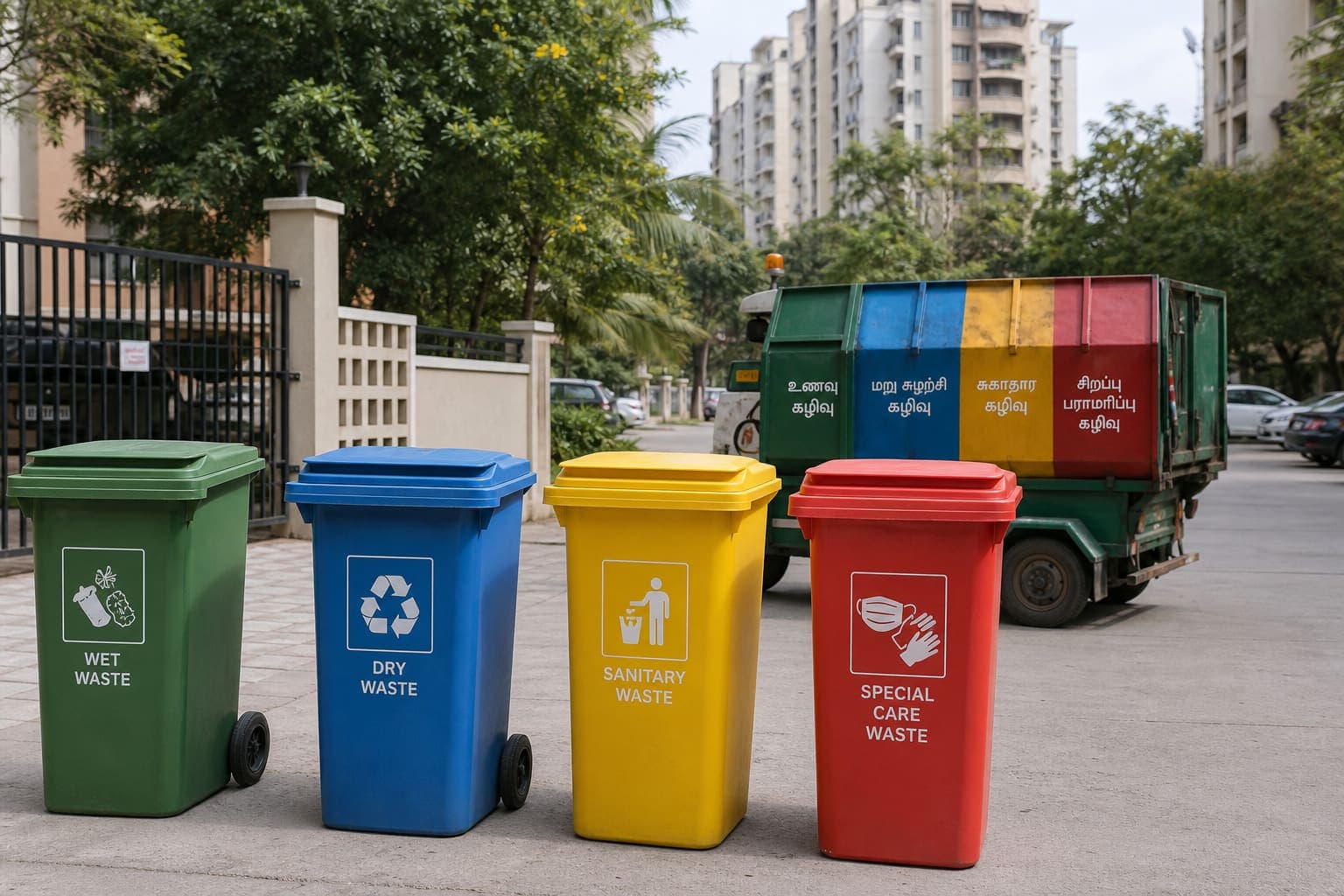
- Under the 2026 Rules, generators must segregate wet (biodegradable), dry (recyclable), sanitary, and special-care waste.
- Bulk Waste Generator (BWG)
- A premises may qualify if it has 20,000 sq m or more built-up area, uses 40,000 litres or more of water a day, or generates 100 kg or more of solid waste a day. Meeting any one threshold can be enough.
- Local bye-law deadline
- Rule 39 requires every urban local body to frame bye-laws incorporating the new provisions by 31 March 2027. As of July 2026 reporting, Greater Chennai Corporation is still inside that transition window.
Always verify current obligations from the Gazette notification, GCC or state circulars, sanctioned bye-laws, and any notice issued to your premises. Where an official text differs from this summary, the official text prevails.
What we know
Summary
Chennai, July 2026 — The Greater Chennai Corporation’s current Solid Waste Management Bye-Laws were framed in 2019 and sanctioned by the Tamil Nadu government in January 2020. They repeatedly rely on the now-superseded Solid Waste Management Rules, 2016.
The new national Rules give urban local bodies until 31 March 2027 to frame bye-laws incorporating the revised provisions — but Chennai cannot wait until the deadline to clarify enforcement, user fees and Bulk Waste Generator obligations.
GCC has begun implementing the Solid Waste Management Rules, 2026 through registration drives, segregation directions and enforcement measures. Yet the principal local regulatory document available for Chennai — the Corporation of Chennai Solid Waste Management Bye-Laws, 2019 — continues to be built around the earlier 2016 Rules.
This creates a critical question:
Can Chennai enforce the substantially revised 2026 framework using municipal bye-laws that still define obligations, waste streams, Bulk Waste Generators, penalties and collection systems through the language of the superseded 2016 Rules?
The legal position requires care.
The 2019 bye-laws do not automatically disappear merely because the Union government has replaced the 2016 Rules. They may continue to operate to the extent that they are not inconsistent with the new national Rules. However, the Solid Waste Management Rules, 2026 expressly require every urban local body to frame bye-laws incorporating the new provisions by 31 March 2027.
Greater Chennai Corporation has therefore not yet crossed the statutory deadline. But this does not eliminate the immediate need for amendments, interim orders and clear public guidance.
Chennai’s final bye-laws were framed in 2019, not 2016
One document hosted by GCC is titled “Draft Solid Waste Management Bye-Laws, 2016.” Its opening page says the draft was framed to implement the Solid Waste Management Rules, 2016 and under Section 349 of the Chennai City Municipal Corporation Act, 1919.
That draft should not be confused with the final sanctioned bye-laws.
The final local framework is the Corporation of Chennai Solid Waste Management Bye-Laws, 2019.
The Tamil Nadu Municipal Administration and Water Supply Department sanctioned these bye-laws through G.O. (2D) No. 9 dated 10 January 2020. The order records that:
- the Greater Chennai Corporation Commissioner forwarded the proposal on 21 October 2019;
- the Special Officer-Council approved it through Resolution No. 740/2019 dated 20 November 2019;
- the state government sanctioned the Solid Waste Management Bye-Laws, 2019 under the Chennai City Municipal Corporation Act, 1919;
- the bye-laws were expressly framed based on the Solid Waste Management Rules, 2016.
The accurate description is therefore:
Chennai’s operative local solid-waste bye-laws were framed in 2019 and sanctioned by the Tamil Nadu government on 10 January 2020, based on the national Solid Waste Management Rules, 2016.
They should not simply be described as “2016 bye-laws,” although an earlier draft carried that title.
The national legal foundation changed on 1 April 2026
The Union Ministry of Environment, Forest and Climate Change notified the Solid Waste Management Rules, 2026 through S.O. 388(E) dated 27 January 2026. The notification was published in the Gazette on 28 January and came into force on 1 April 2026. It expressly superseded the Solid Waste Management Rules, 2016, while protecting actions already taken or omitted under the earlier framework.
The new Rules are not a minor amendment.
They introduce or expand several regulatory components, including:
- four-stream segregation;
- a wider definition of Bulk Waste Generator;
- Extended Bulk Waste Generator Responsibility;
- compulsory online registration and reporting;
- geo-tagging and digital monitoring;
- special-care waste collection centres;
- environmental compensation;
- updated user-fee mechanisms;
- revised obligations for local bodies, processors and concessionaires;
- annual reporting on the implementation of municipal bye-laws.
The 2019 Chennai bye-laws were not designed around these provisions.
The 2026 Rules directly require new local bye-laws
Rule 39 of the Solid Waste Management Rules, 2026 sets out the duties of urban local bodies.
It states:
“All Urban Local bodies shall frame by-laws incorporating the provisions of these rules by 31st March 2027.”
This is a direct statutory obligation, not merely a recommendation.
The deadline means GCC has a transition period extending until 31 March 2027. Therefore, it would be inaccurate to report in July 2026 that GCC has already violated the deadline for revising its bye-laws.
The defensible finding is different:
GCC is presently operating within the transition period, but its existing 2019 bye-laws do not fully reflect the new national framework. Until amendments are notified, Chennai requires clear interim directions identifying which provisions of the old bye-laws remain applicable and how new obligations under the 2026 Rules will be administered.
Where the 2019 Chennai bye-laws no longer align with the new Rules
A comparison of the two frameworks shows several material differences.
1. Three-stream segregation versus four-stream segregation
The 2019 Chennai bye-laws require waste generators to segregate waste into:
- biodegradable waste;
- non-biodegradable waste;
- domestic hazardous waste.
They also place wrapped sanitary waste in the dry or non-biodegradable waste stream.
The 2026 Rules require four distinct streams:
- wet waste;
- dry waste;
- sanitary waste;
- special-care waste.
This is not merely a change in terminology.
Under the new system, sanitary waste is no longer treated simply as part of dry waste. Special-care waste — including materials such as discarded paint containers, bulbs, mercury thermometers and expired medicines — must also be separately managed through authorised agencies or designated collection centres.
Chennai’s local bye-laws must therefore be amended to specify:
- four-stream storage requirements;
- bin or container standards;
- collection frequency;
- authorised collection channels;
- treatment and final disposal arrangements;
- penalties for mixing these streams.
2. The definition of Bulk Waste Generator has changed
The 2019 Chennai bye-laws define a Bulk Waste Generator largely through a single criterion: an average waste-generation rate exceeding 100 kilograms per day.
The 2026 Rules use three alternative thresholds. An establishment can qualify as a Bulk Waste Generator if it meets at least one of the following:
- building floor area of 20,000 square metres or more;
- water consumption of 40,000 litres per day or more;
- solid-waste generation of 100 kilograms per day or more.
This substantially broadens the classification.
An institution may now become a BWG based on its size or water consumption even where its measured daily waste has not been established at more than 100 kilograms.
Unless GCC revises its local framework, an establishment reading only the 2019 bye-laws could misunderstand whether it falls within the new category.
3. The old bye-laws expressly define “Rule” as the 2016 Rules
The 2019 Chennai bye-laws contain a definition stating that “Rule” means the Solid Waste Management Rules, 2016.
That national framework has now been superseded.
This reference requires formal correction. Otherwise, multiple clauses in the local bye-laws remain textually linked to a set of central Rules that is no longer the current governing framework.
4. No local framework yet for Extended Bulk Waste Generator Responsibility
The 2026 Rules introduce Extended Bulk Waste Generator Responsibility, or EBWGR.
BWGs must ensure environmentally sound collection, transportation and processing. Where on-site wet-waste processing is not feasible, the new system provides for an EBWGR certificate mechanism.
The Rules require urban local bodies to:
- issue EBWGR certificates covering total solid waste;
- notify the certificate cost;
- include the cost in the bye-laws or another appropriate local regulation;
- obtain approval from the state or Union territory government;
- base the fee on norms issued by CPCB in consultation with the Union ministry.
The Chennai bye-laws contain no EBWGR certificate framework because the concept did not exist in the 2016 Rules on which they were based.
This is one of the clearest areas requiring a fresh local regulation.
5. User fees require a new basis
The old Chennai bye-laws provide for user fees and include schedules relating to waste generators and local services. They were structured around the costs and responsibilities existing under the earlier system.
Under the 2026 Rules, user fees remain payable according to local-body bye-laws. The Rules also require local bodies to notify the cost of EBWGR certificates and suitable fines.
GCC therefore needs to clarify:
- whether the existing user-fee schedule remains operative;
- whether new concessionaire or collection charges are being imposed;
- whether BWGs must pay both user fees and an EBWGR certificate cost;
- how fees will be calculated;
- who is authorised to collect them;
- what receipts and compliance certificates must be issued.
Enforcement without an updated and publicly accessible fee framework could produce inconsistent charges and disputes.
6. Special-care waste centres are absent from the old framework
The 2026 Rules require urban local bodies, directly or through third parties, to provide special-care waste collection services.
They also require deposition centres to be established so that one centre serves an area of five square kilometres or part thereof. The local body must notify the operating hours and direct waste generators to deposit special-care waste at these centres.
The old Chennai bye-laws refer to domestic hazardous waste but do not establish this new special-care waste network.
GCC must publish:
- centre locations;
- zone and ward coverage;
- operating days and timings;
- accepted waste categories;
- collection-agency details;
- transport and disposal procedures.
7. Online registration, geo-tagging and digital reporting are new duties
The 2026 Rules establish a centralised online portal covering registration, collection, transportation, processing, disposal and reporting.
Urban local bodies must identify BWGs through detailed surveys, geo-tag them and update the list annually by 1 April. They must also report waste generation and collection through the central portal.
The 2019 bye-laws were built around physical municipal administration, authorised collectors and conventional local records.
They do not provide a complete legal framework for:
- compulsory portal registration;
- geo-tagging;
- digital returns;
- online authorisation;
- audit uploads;
- monthly data disclosure;
- consequences of false online reporting.
8. Environmental compensation is different from municipal fines
The 2019 bye-laws provide for local fines and spot penalties.
The 2026 Rules retain municipal fines but also introduce environmental compensation under the Polluter Pays principle for violations including:
- operating without registration;
- false reporting;
- forged documents;
- improper solid-waste management.
Environmental compensation is to be guided by CPCB and levied by the State Pollution Control Board or Pollution Control Committee.
GCC’s revised bye-laws should clearly distinguish between:
- municipal spot fines;
- user fees;
- service charges;
- EBWGR certificate costs;
- environmental compensation levied by TNPCB;
- prosecution or closure action under other laws.
Without this distinction, businesses and residential communities may not understand which authority is imposing a particular liability or what appeal mechanism applies.
What this means in Chennai
Local impact, institutions, and what residents should watch next.
Can the 2019 bye-laws continue until 31 March 2027?
Broadly, yes — but only as a transitional local framework and only to the extent that their provisions are compatible with the 2026 Rules.
The new national Rules have superior force within the regulatory structure created under the Environment (Protection) Act, 1986. A local bye-law cannot override or dilute a binding obligation contained in the central Rules.
Accordingly:
- an old provision that remains compatible may continue to operate;
- a new duty in the 2026 Rules applies even if it has not yet been copied into the local bye-laws;
- an old provision that directly conflicts with the 2026 Rules cannot be relied upon to defeat the national requirement;
- local fines, user fees and implementation details requiring a bye-law or local notification need an updated legal basis.
The strongest example is segregation.
GCC cannot continue demanding only three-stream segregation merely because the 2019 bye-laws use that structure. The four-stream requirement now arises directly from the 2026 Rules.
But GCC must still amend the bye-laws to specify how that four-stream system will work locally.
The deadline is 31 March 2027 — but the transition cannot remain silent
The Union government has given urban local bodies until 31 March 2027 to frame bye-laws incorporating the new Rules.
This means GCC has approximately one year from the commencement of the Rules to complete the exercise.
However, the implementation of the new Rules began on 1 April 2026. Registration, collection, segregation and enforcement cannot be placed on hold until March 2027.
GCC should therefore publish an interim implementation order immediately, followed by draft amended bye-laws for public consultation.
The interim document should identify:
- provisions of the 2019 bye-laws that remain in force;
- provisions displaced by the 2026 Rules;
- new requirements already applicable;
- competent officers for registration and enforcement;
- current penalty provisions;
- authorised collection arrangements;
- BWG obligations;
- interim user-fee arrangements;
- appeal and grievance procedures.
Public consultation should not be treated as a formality
Solid-waste bye-laws directly affect:
- individual households;
- apartment associations;
- gated communities;
- street vendors;
- restaurants and hotels;
- hospitals;
- schools and colleges;
- markets;
- IT parks;
- malls;
- industries;
- waste pickers;
- recyclers;
- collection contractors;
- waste-processing companies.
The 2019 bye-laws were approved through a municipal resolution and subsequently sanctioned by the state government. The new bye-laws will require a similar legally valid process under the applicable municipal law.
Before finalisation, GCC should release:
- a draft text;
- a comparison showing changes from the 2019 bye-laws;
- a statement explaining the reason for each major amendment;
- proposed user-fee and fine schedules;
- a zone-wise collection responsibility matrix;
- a public notice inviting objections and suggestions;
- details of stakeholder consultations;
- the final council resolution and government sanction.
Questions GCC and the Tamil Nadu government should answer
Greater Chennai Corporation and the Municipal Administration and Water Supply Department should clarify:
- Has work begun on replacing or amending the 2019 bye-laws?
- Which department or committee is drafting the revised document?
- What is the proposed timeline for public consultation?
- Will the draft be placed before the elected Corporation Council?
- Which provisions of the 2019 bye-laws are presently considered inconsistent with the 2026 Rules?
- What is the interim legal basis for four-stream segregation?
- What penalties can currently be imposed on BWGs?
- Has the EBWGR certificate cost been calculated?
- Has state-government approval been sought for that cost?
- Will existing user-fee schedules be revised?
- When will special-care waste deposition centres be established?
- How will sanitary waste be collected separately?
- When will the updated list of authorised collectors, processors and recyclers be published?
- How will GCC prevent overlapping charges by the Corporation, concessionaires and private providers?
- What appeal procedure is available against classification as a BWG or imposition of a fine?
Updating the bye-laws is not a clerical exercise
The required revision cannot be completed by simply replacing “2016” with “2026” in the title and definitions.
The new national framework changes the structure of municipal solid-waste regulation.
The revised Chennai bye-laws must deal with:
- four-stream segregation;
- expanded BWG thresholds;
- digital registration;
- geo-tagging;
- EBWGR certificates;
- special-care waste centres;
- environmental compensation;
- revised user fees;
- portal-based reporting;
- facility audits;
- concessionaire accountability;
- authorised third-party collection;
- grievance redressal;
- updated fine schedules.
It must also reconcile these duties with Chennai’s current operational model, where collection is divided between concessionaires, GCC vehicles, authorised recyclers and other service providers.
Chennai is within the deadline, but clarity is already overdue
Greater Chennai Corporation cannot presently be accused of missing the 31 March 2027 deadline prescribed in the Solid Waste Management Rules, 2026.
But the existence of that future deadline should not be used to justify present uncertainty.
The 2019 Chennai bye-laws were expressly framed under the Solid Waste Management Rules, 2016. They define the regulatory system through three-stream segregation, a narrower BWG test and an administrative structure that predates EBWGR certificates, centralised online tracking and special-care waste centres.
The national framework changed on 1 April 2026.
GCC must now do two things simultaneously:
- implement the binding provisions of the 2026 Rules; and
- complete a transparent process for revising Chennai’s local bye-laws before 31 March 2027.
Until that work is completed, GCC should publish an authoritative interim framework explaining how the new Rules interact with the existing 2019 bye-laws.
Citizens and Bulk Waste Generators should not have to compare an old municipal notification, a new 144-page Union Gazette, scattered circulars and departmental statements to understand their legal obligations.
The Rules have changed. Chennai’s local regulatory framework must now catch up.
Official sources
This page is an editorial rephrase and analysis based on publicly reported information. Read the original source for full context.
FAQ
No. An earlier draft was titled Draft Solid Waste Management Bye-Laws, 2016, but the operative local framework is the Corporation of Chennai Solid Waste Management Bye-Laws, 2019, sanctioned by the Tamil Nadu government through G.O. (2D) No. 9 dated 10 January 2020, based on the national Solid Waste Management Rules, 2016.
Explore the site
More from mychennaicity.in
Chennai today, local news, jobs, events, gold rate, and a moderated WhatsApp community — one city desk.
- Chennai today60-second morning card
- WhatsApp communityModerated Chennai updates
- Chennai local newsCivic desk & neighbourhood stories
- Afford this areaTake-home vs rent check
- Jobs in ChennaiOpen roles across the city
- Which Chennai are you?Playful neighbourhood quiz
New here? How to use mychennaicity.in — guides for residents, job seekers, admins, and more.
Promote your business to Chennai readers
Get visibility across local news, events, jobs and area pages.
Reader group: The my chennai city reader group — short updates and civil discussion, same standards as the site. Opens WhatsApp after you tap.
Tip the Chennai desk
Spotted something we should look at — safety, civic works, consumer rip-offs, or a human story? A short message is enough; links and dates help.