GCC bulk waste agencies Chennai: reported cancellations and the missing public paper trail
What public records say so far about Chennai’s bulk-waste agency removals — and which cancellation orders, inspection findings and destination trails are still outside the reviewed public domain.
GCC reportedly removed nearly 17–18 Chennai bulk-waste agencies over alleged roadside-compactor dumping. Public records cite 31, 14, two and 17–18 providers — agency-wise orders and evidence remain unpublished.
GCC bulk waste agencies Chennai: reported cancellations and the missing public paper trail — Chennai, Chennai local news
City
Chennai (Greater Chennai Corporation)
Topic
Bulk Waste Generator (BWG) collection agencies
Reported claim (media)
Nearly 17–18 empanelled agencies removed over alleged roadside-compactor dumping
Primary media source
*The New Indian Express*, 30 July 2026
Replacement collectors (as reported)
Ramky and Urbaser for dry, sanitary and special-care waste
Provider counts in public records
31 (2024 NGT-linked status); 14 (2026 NGT-linked status); 2 (GCC sheet); 17–18 (July 2026 media)
Agency-wise public orders
Not identified in the reviewed public record
Related framework
Solid Waste Management Rules, 2026
Solid Waste Management Rules
Quick answers
Straight facts from this report for readers — and for search and answer engines. This is a news summary, not legal advice.
Direct answer
As of 30–31 July 2026 reporting, a senior Greater Chennai Corporation official was quoted as saying nearly 17–18 bulk-waste agencies were removed after alleged dumping of Bulk Waste Generator waste into roadside compactors. Separate public records still refer to 31, 14, two and 17–18 providers; agency-wise orders and inspection findings were not in the reviewed public domain.
Media coverage also said dry, sanitary and special-care collection shifted to Ramky and Urbaser. This page maps attributed claims against public-record gaps. It does not conclude that any named or unnamed agency committed an offence.
From this story
- Attributed claim
- Nearly 17–18 empanelled agencies cancelled, per a senior GCC official quoted by The New Indian Express (30 July 2026).
- Provider counts in public materials
- 31 (2024 NGT-linked status), 14 (2026 NGT-linked status), two (GCC sheet for four zones), 17–18 (July 2026 media).
- Still unpublished in reviewed materials
- Complete agency list, order type per agency, inspection evidence, show-cause replies, and zone-wise wet-waste destination advisory.
National framework (shared across this series)
The Solid Waste Management Rules, 2026 were notified by the Union Ministry of Environment, Forest and Climate Change through S.O. 388(E) dated 27 January 2026, published in the Gazette on 28 January, and came into force on 1 April 2026. They supersede the Solid Waste Management Rules, 2016.
- Four waste streams
- Under the 2026 Rules, generators must segregate wet (biodegradable), dry (recyclable), sanitary, and special-care waste.
- Bulk Waste Generator (BWG)
- A premises may qualify if it has 20,000 sq m or more built-up area, uses 40,000 litres or more of water a day, or generates 100 kg or more of solid waste a day. Meeting any one threshold can be enough.
- Local bye-law deadline
- Rule 39 requires every urban local body to frame bye-laws incorporating the new provisions by 31 March 2027. As of July 2026 reporting, Greater Chennai Corporation is still inside that transition window.
Always verify current obligations from the Gazette notification, GCC or state circulars, sanctioned bye-laws, and any notice issued to your premises. Where an official text differs from this summary, the official text prevails.
What we know
Quick answer
As of 30–31 July 2026, a senior Greater Chennai Corporation (GCC) official was reported as saying that the empanelment of nearly 17–18 bulk-waste agencies in Chennai had been cancelled after operators were allegedly found depositing Bulk Waste Generator (BWG) waste in roadside compactor bins. Separate GCC-linked public records have referred at different times to 31, 14, two and 17–18 providers. The reviewed public domain does not yet identify every affected agency or publish agency-wise orders, inspection findings or waste-destination records. This article maps what is publicly attributed so far — and what remains unpublished.
Editorial disclosure
This report is based on publicly accessible GCC materials, official regulatory information, National Green Tribunal-related records identified during research, and media reports available as of 31 July 2026.
mychennaicity.in has not independently concluded that any individual agency, company, generator or official committed an offence or other wrongdoing. Claims about dumping, absence of functional processing facilities or breach of service conditions remain attributed to the sources named below and should be assessed against official records and any replies from affected parties.
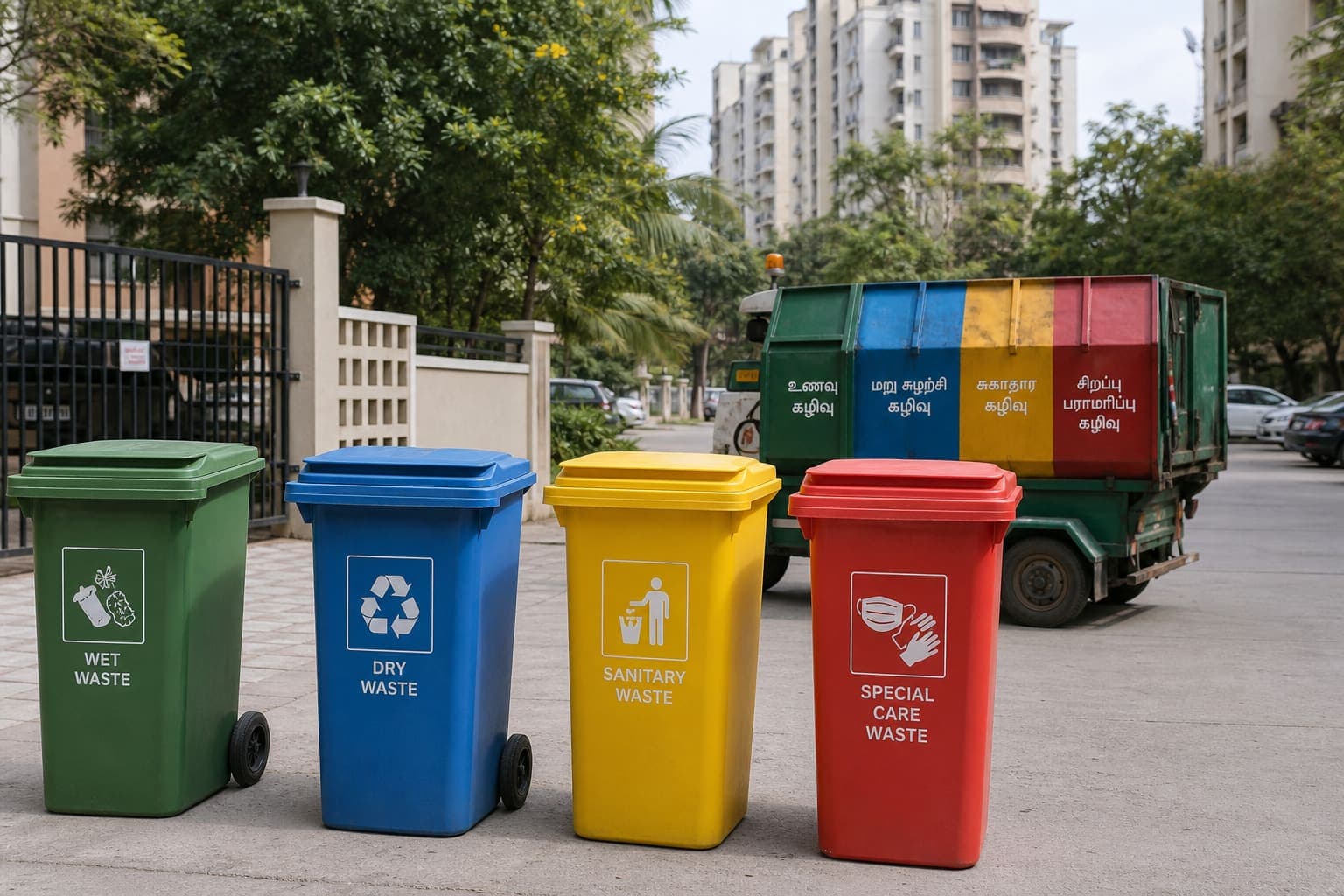
The hero image is a representational waste-segregation illustration. It is not a photograph of any agency, collection vehicle, processing plant, roadside bin or alleged dumping incident discussed here.
Summary
Chennai, 31 July 2026 — Greater Chennai Corporation has been reported as cancelling or discontinuing nearly 17 to 18 agencies engaged to collect waste from Bulk Waste Generators, after allegations that some operators deposited collected waste in roadside compactor bins instead of taking it to authorised processing facilities.
If agencies entrusted with segregated bulk waste returned that material to Chennai’s ordinary municipal collection chain, the operational consequences could include remixing of streams, extra load on public compactors and municipal vehicles, and material intended for processing entering transfer stations or dumping grounds. Those outcomes remain conditional on the underlying evidence.
Public materials reviewed for this article do not yet provide a complete agency-wise documentary trail: names of all affected operators, order numbers, inspection reports, vehicle or GPS trails, show-cause notices, replies, or destination-facility weighment records.
That gap does not establish that the records are absent. It establishes that they have not yet been placed in the reviewed public domain.
What GCC is reported to have found
A 30 July 2026 report by The New Indian Express, citing a senior GCC official, stated that nearly 17 to 18 empanelled agencies had been removed after they were allegedly found depositing waste collected from Bulk Waste Generators in roadside compactor bins.
The official was also reported as saying that most agencies could not demonstrate functional waste-processing facilities. One operator associated with the Chetpet Bio-CNG facility was described as an exception.
According to the same report, responsibility for collecting dry, sanitary and special-care waste from Bulk Waste Generators was later assigned to Ramky and Urbaser, private concessionaires already involved in municipal solid-waste operations in parts of Chennai.
These remain attributed official claims. The reviewed public record does not presently contain an agency-wise evidentiary account of what each operator allegedly did, where incidents occurred, or what administrative action was passed against each one.
Cancellation, expiry or restructuring?
The legal character of GCC’s step is not yet clear from public materials alone. Cancellation, suspension, termination, expiry and non-renewal are not interchangeable:
| Term | Ordinary meaning |
|---|---|
| Cancellation | An existing authorisation withdrawn before scheduled expiry |
| Suspension | Temporary stop while an inquiry or corrective process continues |
| Non-renewal | Authorisation ends without extension |
| Restructuring | Operating model discontinued and work shifted to other providers |
Media reports have described agencies as “scrapped” or their empanelment cancelled. GCC-linked filings before the National Green Tribunal have also described a shift after representations from elected representatives and public feedback: an initial group of 14 authorised service providers for segregated BWG collection, later replaced by existing concessionaires.
Both accounts may be compatible — public feedback may have prompted inspections that then led to restructuring — but GCC has not yet published a single sequence that reconciles enforcement findings with administrative redesign.
Open questions that remain on the public record include whether every agency was proceeded against individually; whether some permissions were already expiring; whether the entire empanelment model was discontinued; whether only some agencies were found non-compliant; and whether penalties, recoveries or blacklisting orders were issued.
Provider counts in public records
Different public sources use different counts. They may refer to shortlists, wet versus dry categories, zone allocations, active permissions or different years.
| Figure | Where it appears | What it may refer to |
|---|---|---|
| 18 + 12 | 2019 media coverage of GCC shortlists | Firms shortlisted for wet-waste processing (18) and dry-waste recycling (12); authorisation stated as one year |
| 31 | 2024 GCC status report before the NGT (as reported in research notes) | Service providers then featured on the Corporation website |
| 14 | 2026 GCC-linked NGT status material | Authorised providers initially engaged for BWG collection |
| 2 | GCC service-provider sheet reviewed in prior mychennaicity reporting | Two providers across four zones, with listed expiry 25 July 2026 |
| 17–18 | The New Indian Express, 30 July 2026 | Agencies reportedly removed |
These figures need not contradict one another. Until GCC publishes a reconciled zone-wise register — operator, waste stream, authorisation number, validity, declared facility and current status — readers cannot map each number to a single current list.
Related earlier coverage on this site: Who collects bulk waste in Chennai? Two providers, four zones.
Verification and monitoring questions
The reported finding that agencies lacked functional processing units raises oversight questions about how empanelment and renewals were checked. These questions are not proof that GCC knowingly approved ineligible operators.
Tamil Nadu authorisation practice for solid-waste facilities can involve Consent to Establish or Operate from the Tamil Nadu Pollution Control Board, local-body site clearance, municipal agreements and details of processing capacity. GCC’s own Bulk Waste Generator registration system asks establishments to disclose recycler identity, authorisation number, residual waste handed to GCC, collection frequency and vehicle type.
If documentary evidence later supports the reported findings, relevant public questions include:
- What processing facilities did agencies declare at application?
- Were declared sites inspected before empanelment?
- Were TNPCB permissions verified with the regulator?
- Were monthly collection and processing statements required and reviewed?
- Did GCC compare quantities collected from generators with quantities received at declared facilities?
- Were renewals granted only after fresh verification?
What an evidence trail could look like
If BWG waste collected from a hotel, hospital, mall, apartment complex or institution was placed in a roadside compactor, several record types could help reconstruct movement — without any single record necessarily proving identity of generator or collector:
- Generator: collection agreement, invoice or pickup acknowledgement
- Collector: vehicle number, driver record, trip sheet or GPS route
- Location: ward, zone and compactor identity; nearby CCTV where available
- GCC: lifting schedules, complaints, inspection notes
- Destination: weighbridge or receiving records if material reached a transfer station or dumping ground
GCC’s Solid Waste Management Department states that weighbridges are installed at Kodungaiyur and Perungudi and that surveillance cameras are used at both sites. It also identifies Ramky and Urbaser as private contractors in Chennai’s municipal solid-waste system.
Not every roadside compactor is covered by municipal CCTV. A combination of vehicle, timing, route, inspection and destination records would still be the practical path to independent verification.
Wet waste after the reported change
The 30 July report referred specifically to Ramky and Urbaser handling dry, sanitary and special-care waste. That aligns in broad terms with GCC directions that biodegradable waste should be processed on-site (composting, biomethanation or another approved method), while other streams go to GCC or an authorised agency.
Many Bulk Waste Generators may not have adequate on-site capacity for all wet waste. Hotels, restaurants, marriage halls, malls, hospitals, gated communities, educational institutions and IT campuses can generate large daily volumes of food and other biodegradable waste.
Public materials reviewed for this article do not yet give a full zone-wise advisory answering:
- whether wet waste may be sent to the Chetpet Bio-CNG facility and under what conditions;
- which other authorised biomethanation or composting centres exist and at what permitted capacity;
- who may collect and transport that material;
- what document a generator should retain as proof of lawful processing.
Generator compliance and two-sided transparency
Under the Solid Waste Management Rules, 2026, qualifying establishments must register, segregate into wet, dry, sanitary and special-care streams, process biodegradable waste as required and maintain lawful collection and disposal arrangements. GCC has directed establishments across all 15 zones to register online and has warned that non-compliance may attract penalties. Background: Chennai bulk waste generators — registration under SWM Rules 2026.
Compliance is two-sided. Generators are asked to disclose collectors, destinations and quantities. A current public list of authorised collectors, approved facilities, zone allocations and validity periods is the counterpart that allows generators to verify that their arrangements remain lawful.
Collection is not the same as processing
Entrusting collection to established concessionaires may improve operational coordination. Collection alone does not demonstrate scientific processing. The chain that public monitoring would need to see is:
Bulk Waste Generator → authorised collector → identified vehicle → transfer or direct destination → authorised processing facility → recovered material → processing rejects → lawful final disposal.
Periodic public data by concessionaire and waste stream — quantities collected, destinations, quantities composted/biomethanated/recycled, recovered material, rejects, landfill or final disposal, capacity utilisation, complaints and penalties — would allow that chain to be checked for Ramky, Urbaser or any other operator entrusted with the work.
Public cost question
If privately generated waste entered ordinary municipal compactors, GCC may have borne lifting, transport and disposal costs for material that should have been separately managed. That possibility cannot be quantified from records presently available. Estimating cost would require alleged diverted quantity, zones and period, collection and transport costs, concessionaire payment terms, transfer-station and disposal costs, destinations, and any recoveries already made.
Until those figures are published, a specific loss figure would be premature.
What remains unpublished in the reviewed public domain
Based on materials reviewed as of 31 July 2026, the following have not been identified as a complete public package:
- Complete list of agencies affected by the reported decision
- Precise status of each (cancelled, suspended, expired or not renewed)
- Copies or summaries of administrative orders
- Inspection findings and evidence relied upon
- Facilities declared by each operator and their authorisation status
- Show-cause notices and responses, if any
- Penalties, recoveries or blacklisting decisions, if any
- Current zone-wise authorised collector list after the reported change
- Waste-stream responsibilities assigned to each concessionaire
- Authorised destinations for wet, dry, sanitary and special-care waste
- Method through which generators can verify collection and processing
- Monthly collection, processing, recovery, rejection and final-disposal data
Related reading on mychennaicity.in
- Who collects bulk waste in Chennai? Two providers, four zones
- Chennai bulk waste generators: registration under SWM Rules 2026
- Chennai solid-waste bye-laws 2019 vs SWM Rules 2026
- NGT direction on wet and dry waste collection days
- Chennai Corporation zones: 15 vs 20 explained
- BWG readiness checklist 2026
- GCC Solid Waste Management Department
- GCC bulk-waste registration portal
- Greater Chennai Corporation
What this means in Chennai
Local impact, institutions, and what residents should watch next.
How to read the public record
Three layers of material are in play:
- Attributed media claims — what a senior GCC official was reported to have said on 30 July 2026.
- GCC-linked filings and website documents — provider counts, empanelment sheets and NGT status narratives from different years.
- Unpublished agency-wise files — orders, inspections, show-cause papers and destination records that may exist inside the Corporation but are not in the reviewed public domain.
Treating layer 1 as settled fact, or treating layer 3’s absence as proof of non-existence, would both overstate what is currently available.
Why provider counts diverge
The table in the report section shows why 31 / 14 / 2 / 17–18 can coexist without an arithmetic contradiction:
- shortlist versus active authorisation;
- wet-waste versus dry-waste categories;
- multi-zone allocations counted once or many times;
- expired versus current permissions;
- empanelment model versus concessionaire model.
A reconciled register would close most of that ambiguity in one document.
What generators can do while waiting for clearer lists
Pending a current zone-wise public advisory, Bulk Waste Generators can still:
- keep dual-portal registration acknowledgements (GCC and CPCB) ready for inspection;
- maintain four-stream segregation and on-site wet-waste processing where required and feasible;
- retain written collection agreements, vehicle details, weight slips and destination receipts for every lift;
- check GCC’s Solid Waste Management pages and zonal notices for updated authorised collectors;
- avoid depositing commercial or institutional waste in roadside municipal bins.
This is practical risk management, not a substitute for an official operating advisory.
Right of reply
If GCC, any named concessionaire, any former service provider, or counsel for an affected party provides a formal clarification, denial, order copy or correction, mychennaicity.in will update this article in good faith after verification.
Sources and method
Primary and official (as identified in research): Greater Chennai Corporation Solid Waste Management Department pages; GCC service-provider sheet (PDF); GCC Bulk Waste Generator registration portal fields; Solid Waste Management Rules, 2026 framework; National Green Tribunal-related GCC status materials as identified in prior public-record research.
Secondary (media): The New Indian Express (30 July 2026) on reported cancellation of nearly 17–18 agencies; 2019 New Indian Express coverage of GCC shortlists.
Method: Attribution reporting and public-record comparison. No independent forensic finding is made against any agency or official.
Not legal advice. Establishments and operators should follow the latest GCC notices, TNPCB authorisations and applicable rules.
Official sources
This page is an editorial rephrase and analysis based on publicly reported information. Read the original source for full context.
- The New Indian Express (30 July 2026); Greater Chennai Corporation Solid Waste Management pages and service-provider sheet; GCC status materials before the NGT as identified in prior public-record researchPrimary source — open original report
- MyChennaiCity news deskChennai local news and civic explainers
FAQ
A senior GCC official told The New Indian Express on 30 July 2026 that the empanelment of nearly 17–18 agencies was cancelled after many were allegedly found dumping collected Bulk Waste Generator waste into roadside compactor bins. Agency-wise orders naming every operator were not identified in the public materials reviewed for this article.
Explore the site
More from mychennaicity.in
Chennai today, local news, jobs, events, gold rate, and a moderated WhatsApp community — one city desk.
- Chennai today60-second morning card
- WhatsApp communityModerated Chennai updates
- Chennai local newsCivic desk & neighbourhood stories
- Afford this areaTake-home vs rent check
- Jobs in ChennaiOpen roles across the city
- Which Chennai are you?Playful neighbourhood quiz
New here? How to use mychennaicity.in — guides for residents, job seekers, admins, and more.
Promote your business to Chennai readers
Get visibility across local news, events, jobs and area pages.
Reader group: The my chennai city reader group — short updates and civil discussion, same standards as the site. Opens WhatsApp after you tap.
Tip the Chennai desk
Spotted something we should look at — safety, civic works, consumer rip-offs, or a human story? A short message is enough; links and dates help.